Configure your audio interface
- Plug your interface into USB before launching the Audio Engine.
- Input (your instrument): chosen in Jamodio.
- Output (your headphones): follows your OS setting (no picker in the app).
- Set your interface to 48,000 Hz — in the manufacturer's app (Focusrite Control…) or, without an external interface, in the OS.
- On Windows, install your interface's ASIO driver → dedicated guide.
Don't have an external audio interface yet? Start with Why an external audio interface changes everything.
What does a configuration look like?
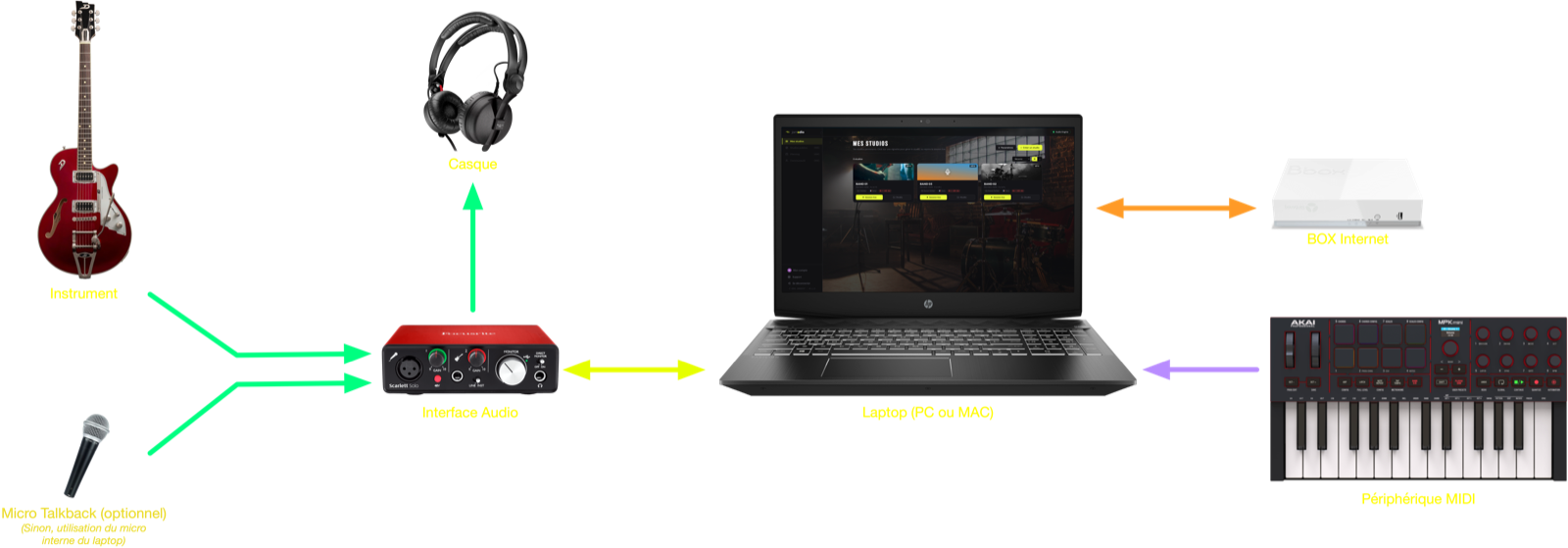
Here's an example of a complete setup to play on Jamodio: instrument and mic on the audio interface, headphones, a MIDI keyboard or drums, and the network connection over Ethernet.
Plug in and select your interface
Plug your interface into USB before launching the Audio Engine. Then two separate settings: input (your instrument) is chosen in Jamodio, output (your headphones) follows your system.
Input — in Jamodio
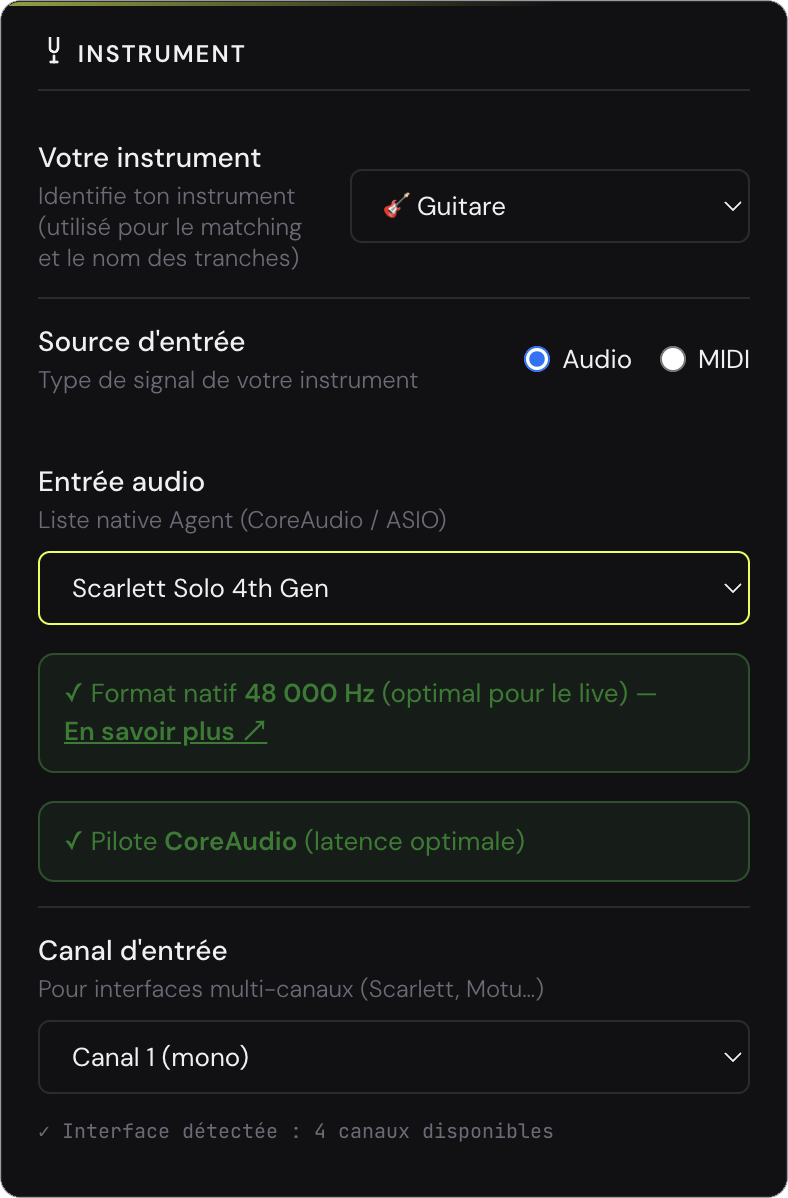
Open Audio settings inside a studio. Under "Audio input", select your interface: Jamodio confirms the native format and the driver, and you pick the channel (mono) for multi-input interfaces.
Output — follows your system
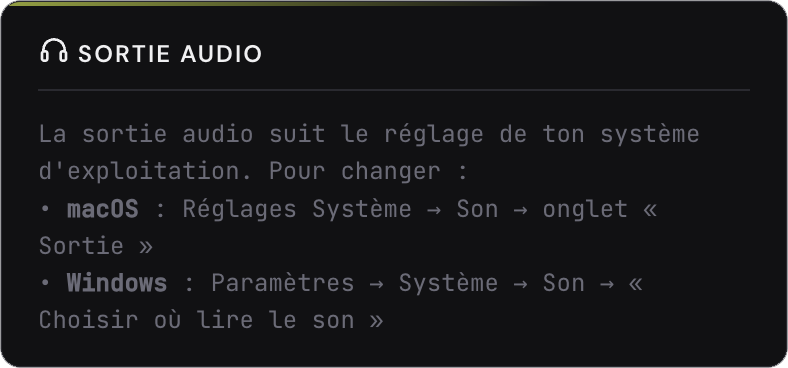
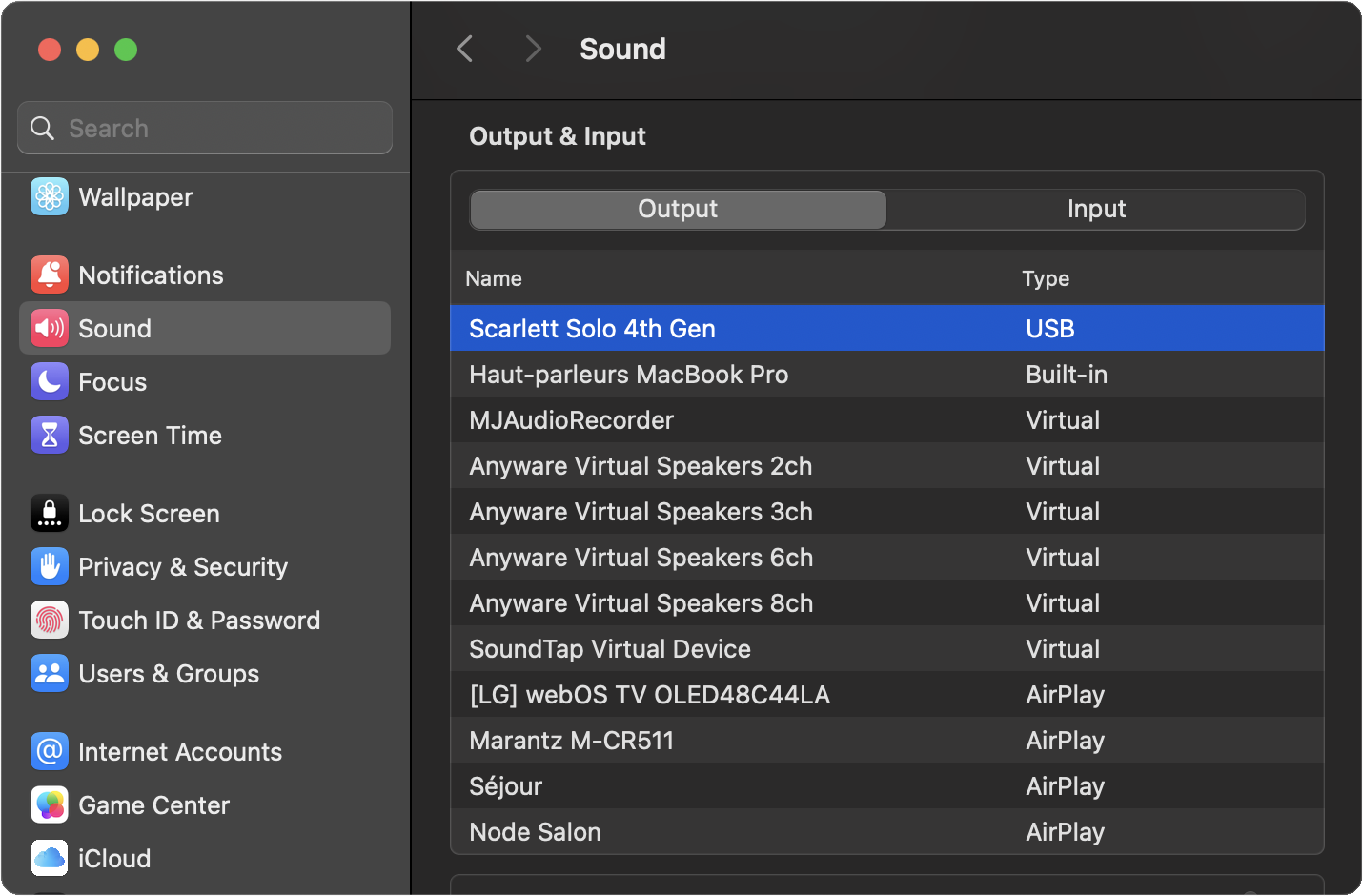
Jamodio sends sound to your OS default output (no picker in the app, to avoid adding latency). To hear yourself through your interface, set it as the system default output:
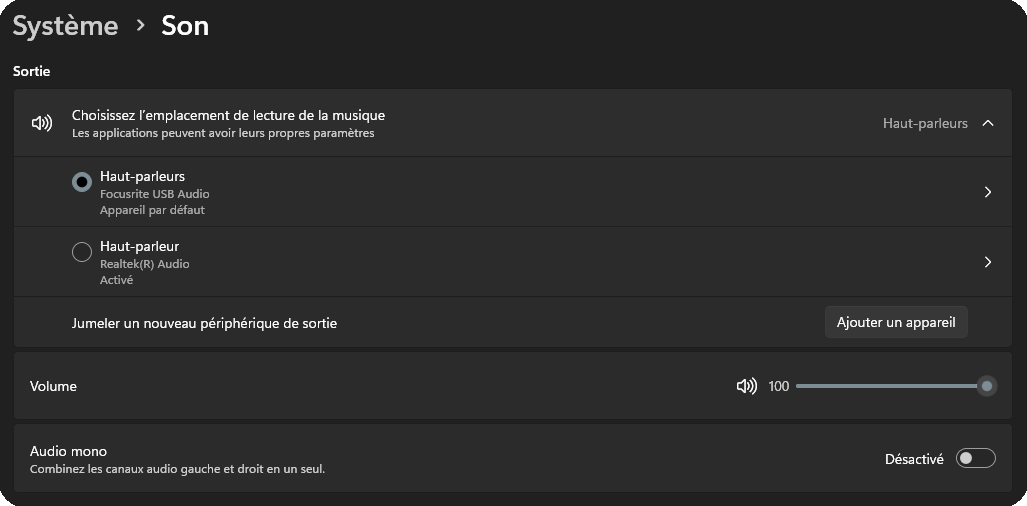
On Windows: the ASIO driver
On Mac, your interface's drivers install automatically via CoreAudio — nothing to do. On Windows, install your interface's ASIO driver (provided by the manufacturer): without it, Windows routes audio through its system mixer (WASAPI) and adds ~10 ms of incompressible latency. Jamodio selects ASIO automatically when the Audio Engine starts.
Set your interface to 48 kHz
One last often-forgotten point: the sample rate must be set to 48,000 Hz. If your interface runs at 44,100 Hz (the other common value, inherited from audio CDs), Jamodio has to resample on the fly and that adds about 29 ms of hidden latency you won't see anywhere — except by playing less tight without knowing why.
Where do you set 48 kHz? It depends on your hardware.
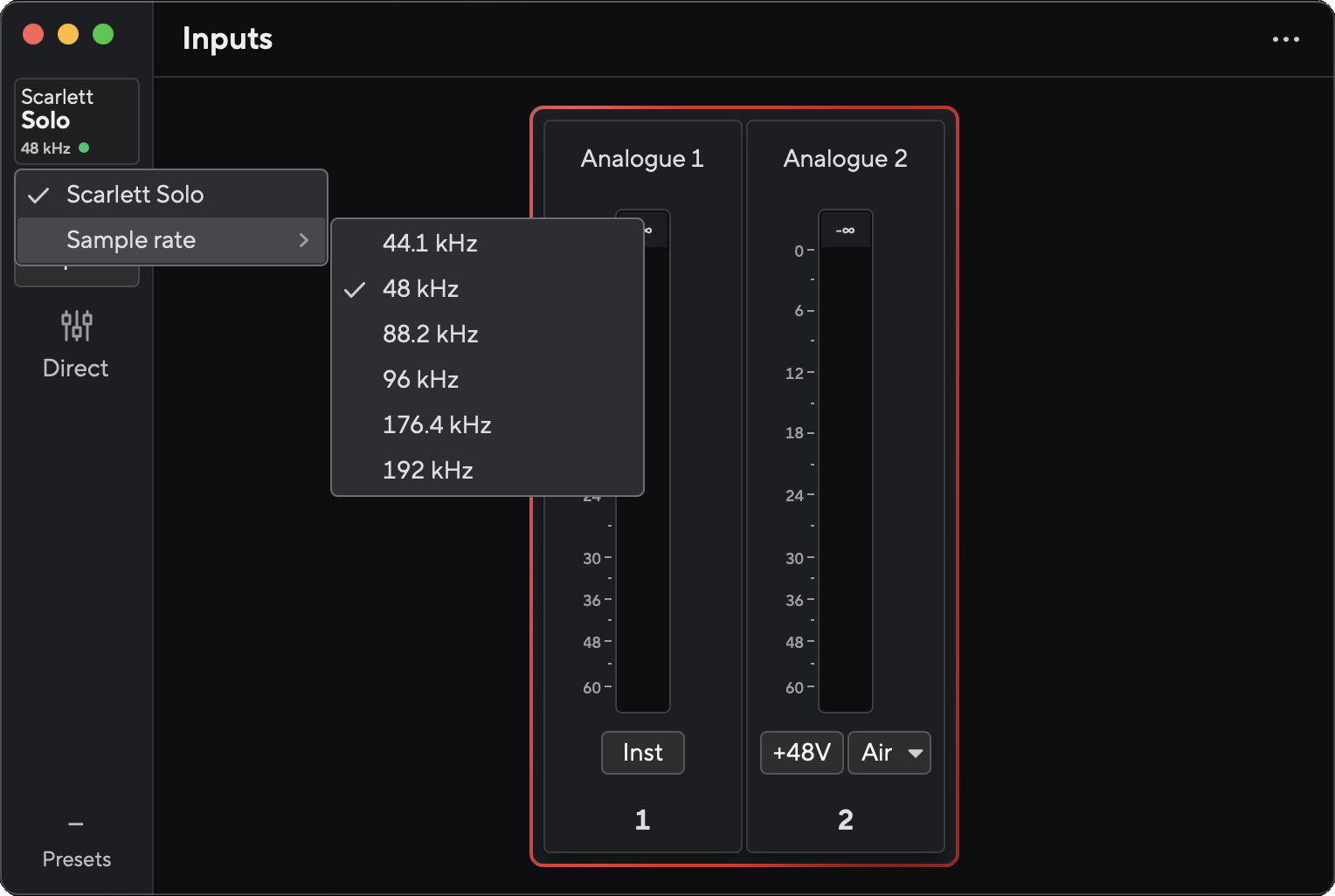
With an external audio interface → the manufacturer's app
On a dedicated interface (Focusrite, Behringer, MOTU, RME…), it's the manufacturer's app that controls the sample rate, not the OS — on Mac as on Windows. Open it and set 48 kHz once and for all. Example with Focusrite Control:
No external interface, on Mac → Audio MIDI Setup
On the built-in card or a USB mic, it's your system that fixes the format. Most devices are already at 48 kHz native on macOS (including the MacBook's mic). To check: open Audio MIDI Setup (in Applications → Utilities), select your device on the left, look at the "Format" field on the right. You should see 48,000 Hz; if it's 44,100, choose 48,000 from the menu.
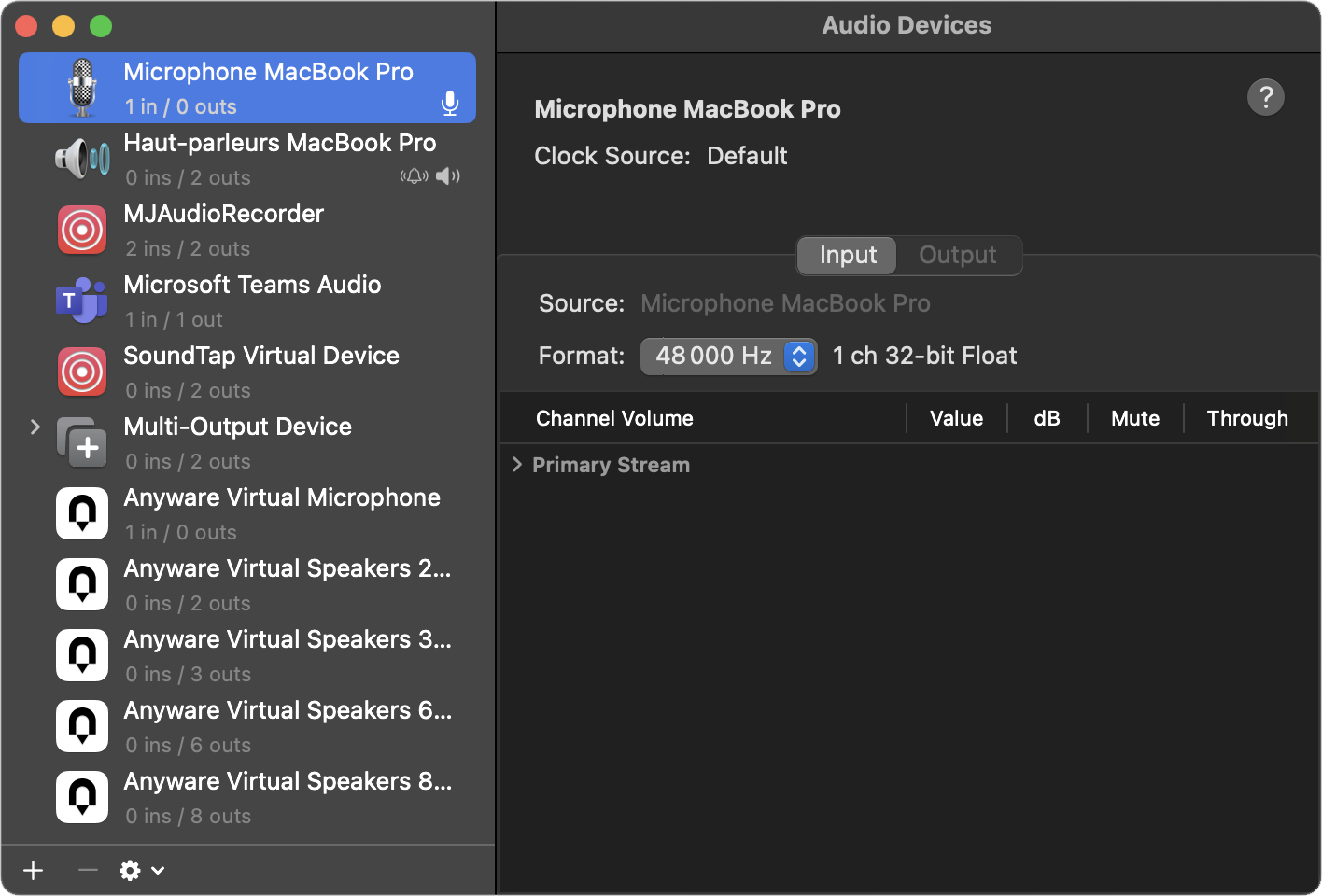
A few low-end USB mics are locked at 44,100 Hz. If Audio MIDI Setup doesn't offer 48,000, the hardware doesn't support it: Jamodio will still work (on-the-fly resampling), but you lose the ~29 ms.
No external interface, on Windows → Sound settings
Windows often sets devices to 44,100 Hz by default, especially built-in Realtek HD Audio chipsets. Conversely, some PCs are already at 48 kHz and don't even offer 44.1 — in that case, nothing to do. To check or fix:
Rare but possible on very old cards or low-end USB mics. In that case Jamodio still works, but with the ~29 ms of hidden latency. For tight live playing, it's time to invest in a real external audio interface → which interface should you pick?
Why 48 kHz and not 44.1 kHz?
44.1 kHz is a legacy of the audio CD (Philips/Sony standard from 1980). 48 kHz became the professional standard: it's what pro studios, film, Pro Tools, Logic, Ableton in session mode, and all modern codecs (Opus, AAC) use. Jamodio uses Opus internally, which is optimized for 48 kHz.
If your devices run at 48 kHz, Jamodio processes them directly, with no conversion. If they're at 44.1 kHz, every sample must be converted on the fly — an operation that requires accumulating a small packet of samples before producing the result. That accumulation delay, plus the anti-aliasing filter delay, is what adds the ~29 ms hidden.
- USB audio interface plugged in (no USB hub — directly into the computer)
- ASIO driver installed (Windows only) — or the audio interface manufacturer's drivers
- Input selected in Audio settings → Audio input
- Interface set as the OS default output
- 48,000 Hz format set (manufacturer app, or OS input AND output)
- Green "Native format 48,000 Hz" badge in Audio settings → Audio input
- Test: play a note (or speak into the mic) → you hear yourself in the headphones with no perceptible delay