Why choose Jamodio?
Looking for a platform to rehearse remotely with your band, or to teach online while playing at the same time as your students? Here is what makes Jamodio different from the six most-cited alternatives in 2026 — a factual, sourced analysis.
Jamodio is the only platform combining in a single tool: your AU and VST3 plugins inside your strip, a mixing console with HD video, shared metronome and synced backing tracks, a persistent studio with its Library (scores, backing tracks, takes), a community to find people to play with, public jam sessions, and room for teachers and students.
None of the historical competitors check all these boxes at once. Here is why.
Coming soon: servers outside France, opened on request from the musicians of a region.
Comparison table
All table cells are based on each product's public information (official websites), September 2026 — sources listed in the detailed cards below. Latency is explained in detail in the note below the table.
| Criterion | Jamodio | JamKazam | Jamulus | SonoBus | NUCorder | JackTrip | FarPlay |
|---|---|---|---|---|---|---|---|
| Note→ear latency (one-way, good setup) | ~20 ms (15 ms between nearby musicians) | ~30 ms | ~22 ms | ~25 ms | ~20 ms (via RTT) | ~18 ms | ~22 ms |
| Community (musician directory, messaging) | (musician profiles) | not documented | not documented | (Meet) | |||
| Public jam sessions (open rooms, by style) | (open sessions) | (public servers) | user-created sessions, not sorted by style | not documented | |||
| In-app audio plugins | Native AU + VST3 | VST + AU (no VST3, 32-bit Win) | (SonoBus IS a plugin) | built-in effects (delay, reverb, amp sim — no VST/AU) | Built-in DSP (no external plugins) | ||
| In-app MIDI virtual instruments (VSTi/AUi played in-app) | Native AU + VST3 | VST/AU (32-bit Win) | (MIDI = mixer only) | via DAW (SonoBus IS a plugin) | via DAW (Audio Bridge) | ||
| Integrated HD video | basic | (external Jitsi) | (external VDO.Ninja) | (Virtual Studio) | |||
| Pro mixer (faders, mute, solo, VU) | basic | Virtual Studio | basic | ||||
| Server-side shared metronome | (distributed) | undocumented | (official forum) | ||||
| Synced backing tracks | (slow-down, pitch shift) | group playback | undocumented | (via input devices) | |||
| Multi-track stem recording | local mix | group | aligned stems | ||||
| Teaching focus (teachers/students) | explicit | partial (Virtual Studio for schools) | |||||
| Network architecture (scaling) | Server (SFU) | P2P / server (hybrid) | Server | P2P (caps at ~4-5) | Server | Server | P2P (caps at ~4-5) |
| Business model | SaaS subscription | Freemium (SaaS) | Free OSS | Free OSS | Freemium (SaaS, FR) | Freemium (OSS + paid cloud) | Freemium (SaaS) |
| Open-source | GPL | GPLv3 | GPL |
About latency — the figures in the table are one-way, from the note played to the partner's ear, in good conditions (native app, audio interface, Ethernet). They remain hard to compare: most vendors do not say what their figure includes, in particular the audio interface and system part, often the heaviest. Where a vendor quotes a round trip, we halved it. Jamodio measures what it can verify, shows separately what drivers declare, and optimises the chain from the sound card to the other person's ear. Its figure covers that whole chain: about 20 ms, and 15 ms between musicians who live close to each other.
"Undocumented" cells — For NUCorder, some features (shared metronome, synced backing tracks) are not explicitly documented on their official site as of this analysis. Rather than making things up, we say so honestly. If you know NUCorder better than we do, please send corrections via the contact page.
Network architecture & scaling — with P2P (SonoBus, FarPlay, JamKazam on its free tier), each musician sends their stream directly to every other peer: each person's upload grows with the number of peers and, on a home connection, this usually saturates beyond ~4-5 participants (FarPlay itself recommends a server model beyond ~8). A server model (Jamulus, NUCorder, JackTrip — or Jamodio's SFU) sends your stream to the server only once, which then redistributes it: per-client upload stays constant regardless of group size (at the cost of a short server round-trip). That's why Jamodio's SFU handles larger groups without saturating connections.
Each competitor in detail
The table does not tell the whole story. Each tool has its audience, its history, strengths that don't fit in a cell. Here is an honest read of each, by use case.
JamKazam
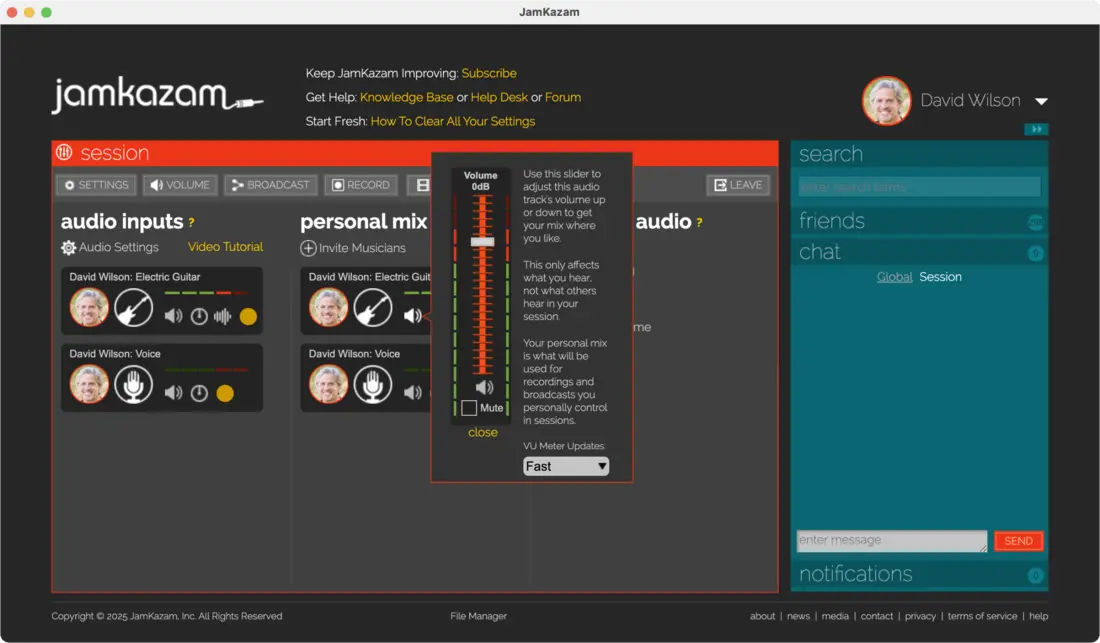
Strengths of JamKazam
- Historical platform (since 2014), large US community
- Distributed metronome server-side — a unique feature among the old guard
- Native VST + AU plugins (insert effects + MIDI instruments)
- Backing tracks with slow-down and pitch shift — handy when learning a song
- Still actively maintained in 2026 (regular news)
Its main limitation versus Jamodio
- No VST3 and 32-bit-only plugins on Windows (effects as well as instruments) — excludes most modern plugins (recent Native Instruments, Plugin Alliance…)
- Aging interface (~2014), UX not intuitive for beginners
Source: official site
Jamulus
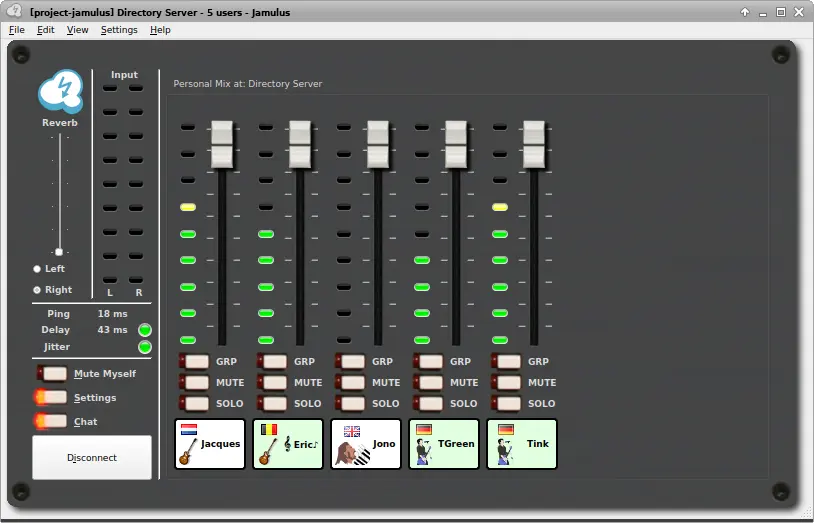
Strengths of Jamulus
- Very low latency on LAN or dedicated fiber (audio only, OPUS-compressed, UDP)
- 100% free and open-source (GPL) — community servers
- Project actively maintained since 2006
Its main limitation versus Jamodio
- No video (Jitsi/Zoom on the side, out of sync)
- No chat, no backing tracks, no plugins, no shared metronome
- No MIDI virtual instruments — MIDI only drives the mixer (volume, pan, mute)
- Very raw interface, 2010-era look, technically demanding (NAT setup, server choice)
- No stem recording — only a local mix per client
Source: official site
SonoBus
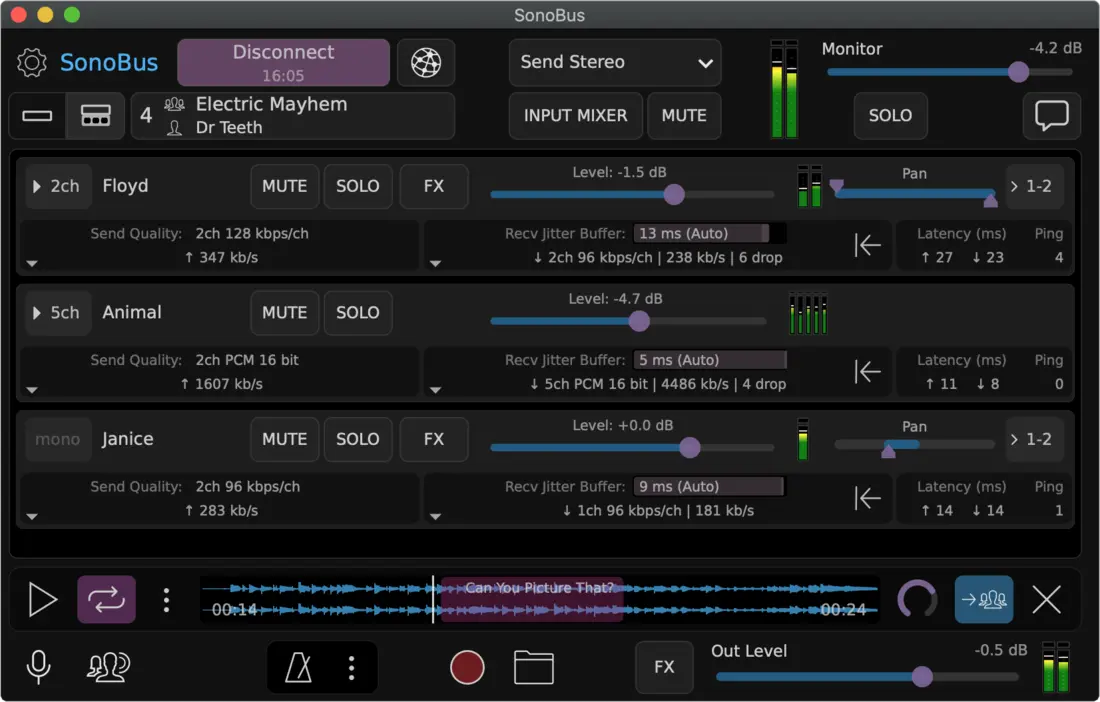
Strengths of SonoBus
- Available as a VST3/AU/AAX plugin to insert into your DAW
- Peer-to-peer architecture (no central server)
- OPUS compression or uncompressed PCM
- Modern UI, decent mixer, basic in/out effects
Its main limitation versus Jamodio
- SonoBus IS an audio transport plugin — it is not a host for external plugins like AmpliTube or Valhalla
- No virtual MIDI instruments of its own — the instrument must run in your DAW
- No native video (button linking to VDO.Ninja, a third-party service)
- No teaching focus, no synced backing tracks, no shared metronome
- P2P architecture — tighter NAT/firewall config, and each peer's upload saturates beyond ~4-5 musicians (no server to fan out)
Source: official site
NUCorder
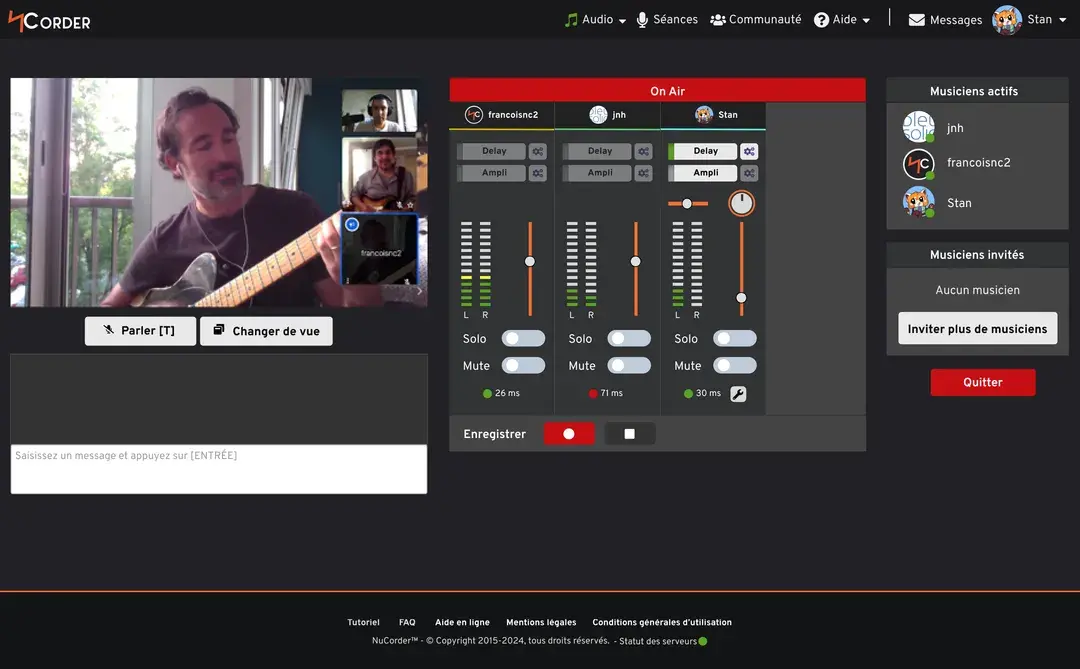
Strengths of NUCorder
- French solution, French support, hosted in France
- Integrated video for participants
- Built-in in-house effects (delay, reverb, amp simulation)
- UI more polished than classic open-source options
- Local NALS agent (NuCorder Audio Local Service) + browser UI architecture
Its main limitation versus Jamodio
- In-house effects only (delay, reverb, amp simulation) — no VST3/AU host for your own plugins
- No MIDI virtual instruments — requested by users, not implemented
- No explicit teacher/student tools
- Smaller community than international solutions
- Shared metronome, synced backing: not publicly documented
Source: official site
JackTrip
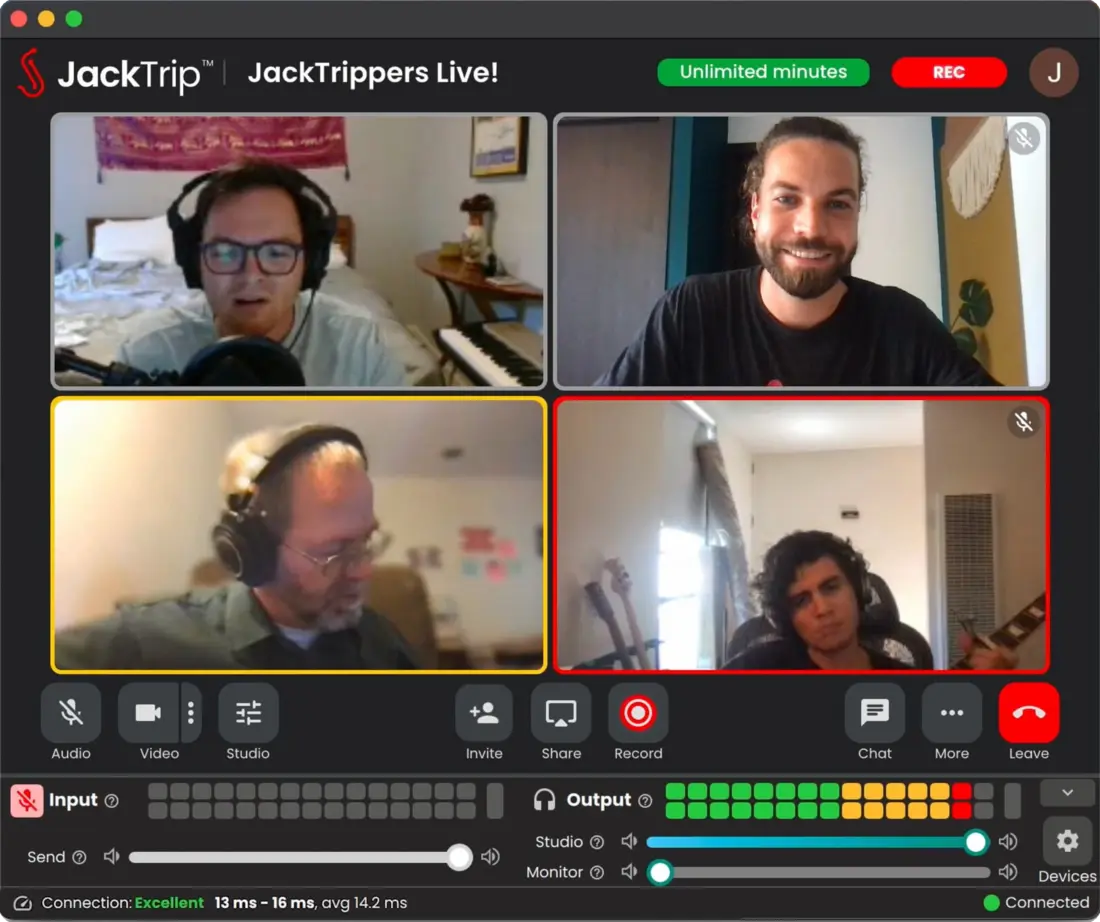
Strengths of JackTrip
- Record-low latency (uncompressed audio) on LAN or dedicated fiber
- Virtual Studio with built-in DSP (reverbs, compression…)
- JackTrip WebRTC = HTML5 browser version
- Built-in chat, aligned stem recording
Its main limitation versus Jamodio
- Advanced setup (JACK Audio, sometimes the command line) — not for the general public
- No external hosted plugins (only built-in DSP, no third-party AU/VST3)
- No virtual MIDI instruments of its own — the instrument runs in your DAW, bridged via the "Audio Bridge" plugin
- Uncompressed audio = requires excellent symmetric fiber
- No teaching angle (geared toward choirs/orchestras)
- "Virtual Studio" = a paid managed cloud service (run by JackTrip Labs, Palo Alto, US; $4–16/mo subscription) — the open source alone stays audio-only, with no turnkey server or video
Source: official site
FarPlay
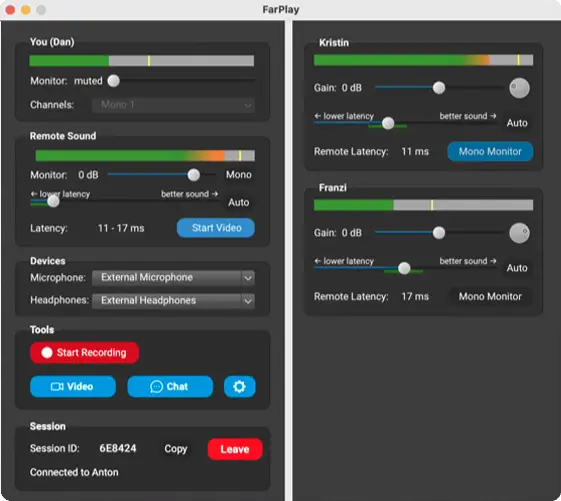
Strengths of FarPlay
- Modern, polished UI designed for pro musicians
- Integrated HD video, uncompressed PCM audio
- Per-channel reverb in the mixer (since v1.3)
Its main limitation versus Jamodio
- No in-app audio plugins (virtual audio devices workaround)
- No MIDI virtual instruments — no built-in MIDI support at all (confirmed by their team)
- No metronome — confirmed on their official forum
- Backing tracks = just combining input devices, no server-side sync
- No teacher/student angle
- P2P architecture — beyond ~4-5 musicians each peer's upload saturates (FarPlay itself recommends a server model beyond ~8)
- Permanent free tier but very limited (1-on-1, 45 min, no recording) — group/unlimited use is paid ($5.99–14.99/mo)
Source: official site
6 reasons to choose Jamodio
On the 2026 market of remote rehearsal platforms, Jamodio is the only product bringing these six characteristics together at once. No competitor checks all six.
Finding people to play with
A musician directory, free, open once your profile is complete, filterable by instrument, style, level and distance, with messaging to talk and a one-click invitation into your studio. Public jam sessions by style, open to every member, where you see who's playing and how far before you enter. The other platforms leave you alone with your contact list.




Your plugins, in your strip
Load your already-installed plugins (AmpliTube, Valhalla, Surge XT, Logic instruments…) directly into your strip. The only competitor that supports plugins (JamKazam) is limited to VST/AU without VST3 and 32-bit only plugins on Windows.
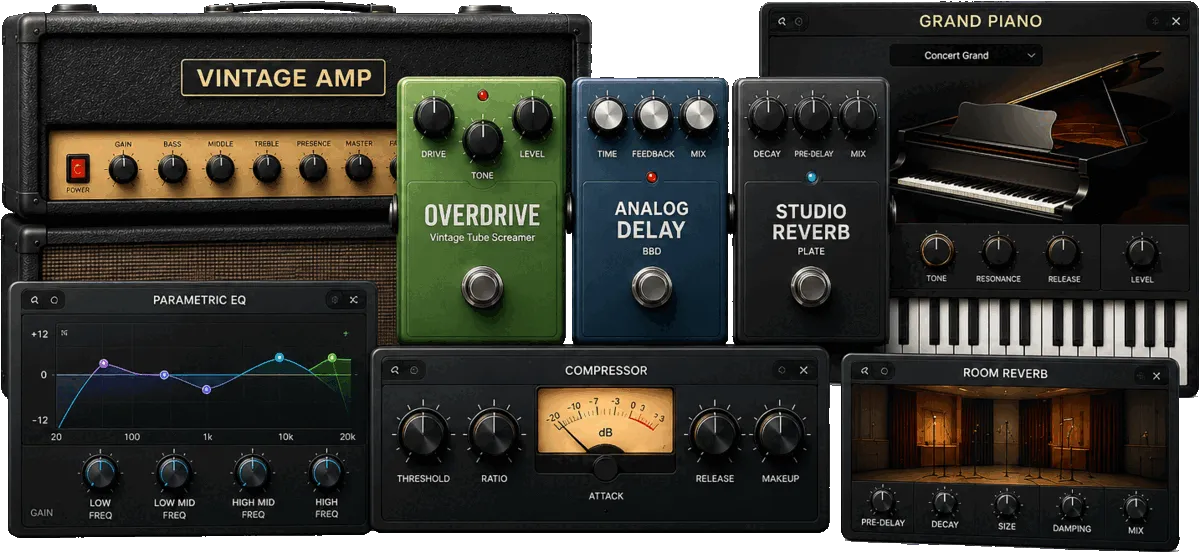
A mixing console, video, chat, recording
Everything in a cohesive interface: one strip per musician, meters, HD video, chat, recording as a mix or as separate tracks. Jamulus and SonoBus have no built-in video.

Shared metronome and synced backing tracks
A tempo locked to the server clock, the whole band on the same grid. The backing track moves forward for everyone at once. FarPlay, Jamulus, SonoBus and JackTrip have none of this.


A persistent studio, with its Library
Each studio keeps its documents, backing tracks, takes and settings from one session to the next. You get your space back ready to go, with nothing to re-upload every rehearsal. No competitor offers a persistent per-studio library.
repet_2026-09-18_MIX.opus · 4:12Room for teachers and their students
A Teacher plan with one studio per student, a score shared and presented next to the cameras, the lesson recorded to listen back. Other lesson-focused tools will come when they exist.
Convinced?
The private beta is full. Opening to the public in November 2026: join the waitlist.